A Thermo-Electric Cooler (TEC), also called a Peltier cooler,
is a solid-state heat pump that cools or heats an object by reversing the direction of DC
current through its terminals. A TEC controller regulates the object's
temperature by precisely controlling both the current direction and amplitude through the TEC.
Analog Technologies has been designing TEC controllers since 1997. Our current
lineup ranges from compact OEM SMT modules (TEC14M, 3.5 A) through DIP-packaged
analog controllers (TECA1 / TEC5V series, 2.5–6 A) up to high-power
industrial controllers (TEC28V15A family, 7–15 A) and digital chamber
controllers (ATFC106D, 20 A). Our patented single-PWM output stage
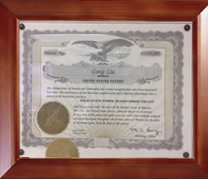
(U.S. Patent 6,486,643 B2) cuts power loss by 20%, BOM cost by 25%,
and PCB area by 35% versus conventional designs — ATI's customer list includes NASA,
US Army, Intel, HP, MIT, and Texas Instruments.
92%
Peak Efficiency
2.5–20A
Output Current Range
up to ±47.5V
Output Voltage Range
14×14mm
Smallest Footprint
Master Comparison: TEC Controller Families at a Glance
Compare supply voltage, TEC output voltage, maximum current, package, and primary use case
side-by-side. Click any part number to jump to its detailed product page.
For over 25 years, we've refined a unique single-PWM H-bridge output stage. Conventional
TEC controllers use two PWM engines; ours uses one. The result:
20% lower power loss — fewer switching transitions, less FET RDS(on) burn-off
25% lower BOM cost — half the gate drivers, half the PWM control IC count
35% smaller PCB area — fewer parts, simpler layout
Gold-coated grounded metal shielding on every standalone module — zero EMI in or out
Vacuum-potted internals — consistent thermal conduction inside-out, ready for space and avionics applications
Auto-PID firmware option on the high-power TEC28V15A / TEC24V10A / TEC18V15A / TEC12V9A / TEC9V7A series — no manual compensation tuning required
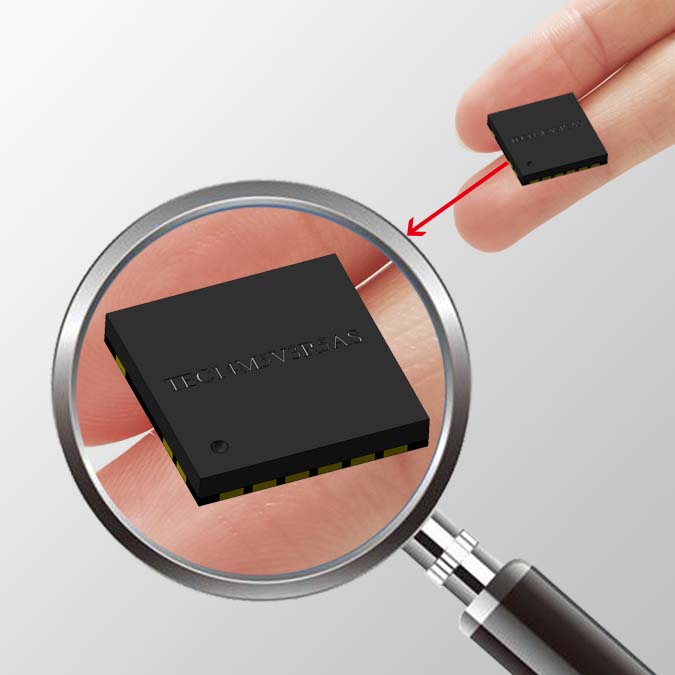
Fully-Molded 14×14 mm Surface-Mount Module for High-Density Photonics PCBs
Ultra-compact, fully-molded SMT TEC controller for butterfly laser packages, TO-can fiber-coupled diodes, coherent optical transceivers, and miniature spectrometers — where every square millimeter of PCB area matters.
ATI's TEC14M5V3R5AS Micro TEC Controller is an ultra-compact, low-profile, fully-molded surface-mount module measuring just 14.0 × 14.0 × 2.2 mm — one of the most compact 3.5 A TEC drivers available. Designed for high-density photonics PCBs (butterfly laser packages, TO-can fiber-coupled diodes, coherent optical transceivers, miniature spectrometers), the TEC14M delivers 90% efficiency, 0.001°C temperature stability, and a bottom thermal pad for direct high-power heat sinking. The module integrates thermistor T–R linearization, set-point/range configuration, TEC voltage limiting, compensation network, TEMPGD loop-status indication, power-up delay, and shutdown — eliminating the external analog circuitry traditionally required around discrete H-bridge designs.
7 – 15 A Output, Built-in Auto-PID Compensation, >92% Efficiency
High-power TEC controllers for industrial laser pump-diode modules, semiconductor process equipment, optical instruments, and high-current TEC arrays. All units include embedded auto-PID firmware that eliminates the compensation-tuning step, with the option to fall back to traditional analog compensation for custom thermal loads.
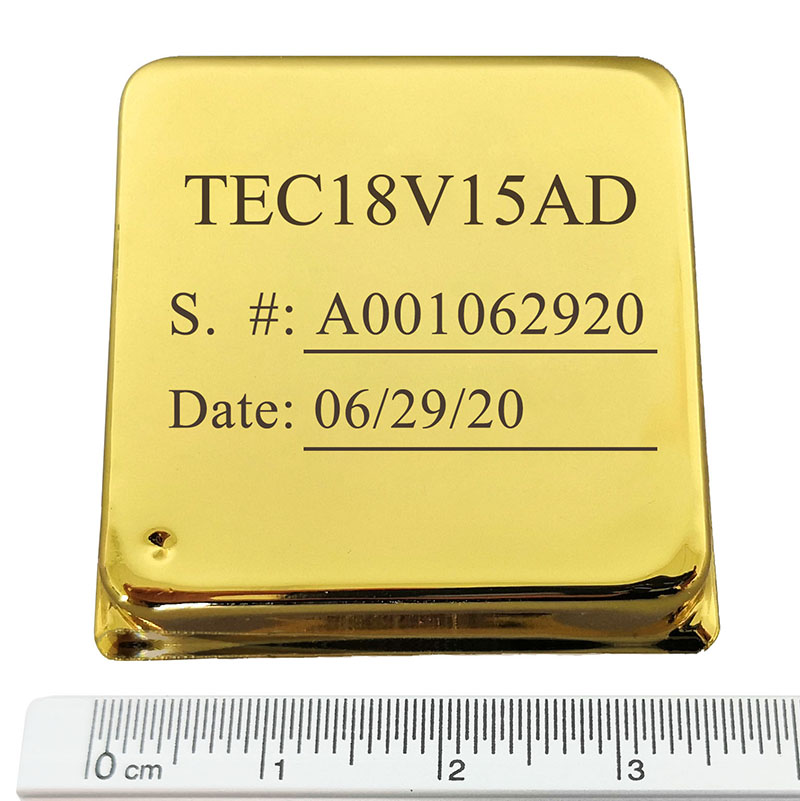
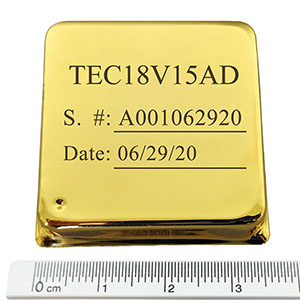
The TEC48V10A / TEC28V15A / TEC24V series (6A / 10A / 15A) / TEC18V15A / TEC12V9A / TEC9V7A family is ATI's flagship high-power, high-efficiency TEC controller lineup — six voltage classes spanning 48 V down to 9 V supply — sharing the same patented single-PWM output stage (U.S. Patent 6,486,643 B2), all running embedded auto-PID firmware that self-tunes the thermal loop without manual compensation-network tuning. Each unit delivers >92% efficiency, ±0.001°C stability, Zero EMI and metal-shielded enclosures, and is available in DIP and SMT packages with optional Auto-PID firmware (D / S / DAPID / SAPID part suffixes). The new TEC48V10A extends the output-voltage envelope to ±47.5V, ideal for stacked TECs and 48V telecom / PoE rails. Engineers can fall back to traditional analog compensation for unusual thermal loads. The whole family shares one universal evaluation board: TEC24V15AEV2.2.
Supply: 5.5–48 V DC (covers all 6 series)
Output current: up to 15 A (TEC28V15A / TEC24V15A / TEC18V15A) | 10 A (TEC48V10A / TEC24V10A) | 9 A (TEC12V9A) | 7 A (TEC9V7A) | 6 A (TEC24V6A)
Output voltage envelope: up to ±47.5V (TEC48V10A) for stacked TECs and high-dT thermoelectric loads
Efficiency: >92% at full load, no external heat sink required below 8 A
Stability: ±0.001°C, zero EMI (gold-coated shielded enclosure)
Firmware: Auto-PID + classical analog compensation option (DIP / SMT)
The TEC5V4A-D family drives TECs up to 4 A from a 5 V supply at 90% efficiency, housed in a fully shielded 6-sided metal enclosure for zero EMI ingress/egress. Three precision grades are offered: -D for general use (|VTEMP − VTEMPSP| ≤ 5 mV), -DA for high-efficiency precision (≤ 2 mV), and -DAH for the highest stability (≤ 0.5 mV, 0.01°C), each in DIP. The metal case is grounded — suitable for EMI-regulated applications.
Efficiency: 90%
Max Current: 4A
Max VTEC: 0 to VVPS (externally adjustable)
Shielding: 6-sided metal enclosure (gold-coated, grounded)
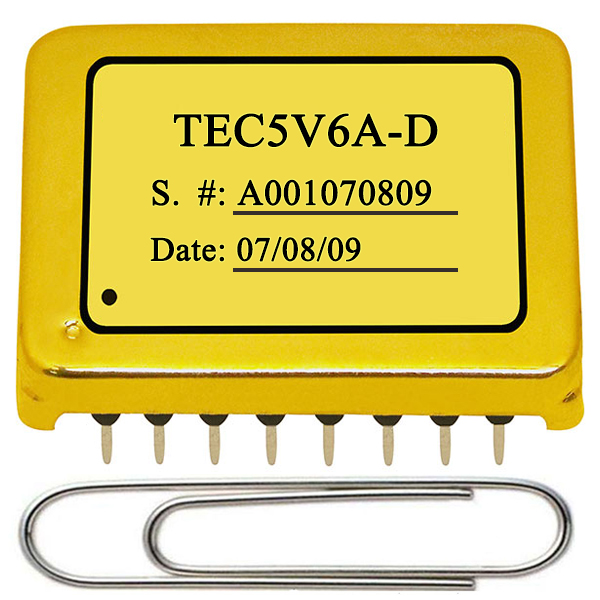
The TEC5V6A-D family extends the 5V architecture to 6 A output, suitable for medium-power TEC modules driving laser-diode pumps and instrument cooling. Same 6-sided shielding as TEC5V4A-D, with the same three precision grades. Default temperature network maps a 10 kΩ @ 25°C thermistor to set-point span 15°C–35°C across 0V–3V on TEMPSP, with the upper limit configurable to about 50°C by raising TEMPSP toward VVPS.
DIP TEC Controllers for Laser-Diode Temperature Control
2.5 A DIP Modules in 6-Sided Metal Enclosure, Zero EMI (General-Use → High-Precision)
The TECA1 family is ATI's workhorse DIP TEC controller line for laser-diode wavelength stabilization. The -D variant is the general-use module for typical laser-diode temperature control; the -DAH upgrade tightens the temperature offset by 25× for narrow-linewidth wavelength locking, atomic frequency references, and wavelength-stabilized DWDM transceivers.
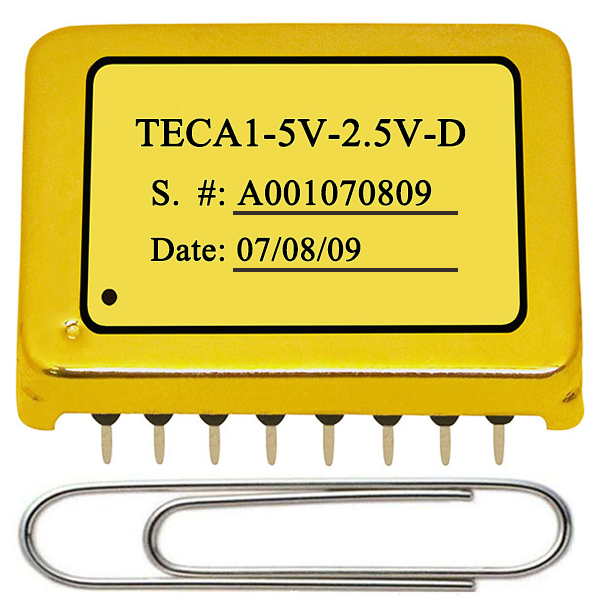
The TECA1-xV-xV-D series is a through-hole DIP module driving up to 2.5 A with 90% efficiency from a 3.3 V or 5 V supply. The maximum output voltage across TEC is externally adjustable from 0 V to VVPS, set-point control voltage swings 0.1 V to VVPS, and the package is 100% lead-free / RoHS compliant. Common variants are stocked for the most-used voltage combinations (5V-5V, 5V-2.5V, 3V-3V). The LD sub-variant (e.g. TECA1LD-5V-5V-D) ships with the compensation network pre-tuned for typical butterfly laser-diode thermal loads, eliminating the compensation-tuning step during prototyping.
Efficiency: 90%
Max Current: 2.5A
VVPS: 3.1–3.5V or 4.75–5.25V (specify when ordering)
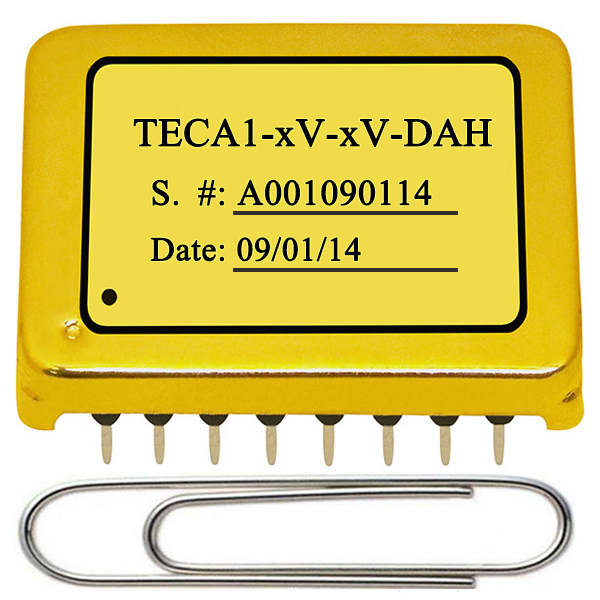
The TECA1-xV-xV-DAH is the precision upgrade of the TECA1-D — same DIP footprint and 2.5 A drive capability, but with the temperature offset between actual and set-point reduced from ±0.1°C down to ±0.004°C (0.5 mV) — a 25× improvement that matters for narrow-linewidth laser wavelength locking and precision photonics applications. Adds an actual-object-temperature monitoring output (VTEMP) for closed-loop logging. The LD variant has the compensation network pre-tuned for laser-diode thermal loads.
Efficiency: ≥90%
Max Current: 2.5A
Stability: 0.004°C (±0.5 mV between VTEMP and VTEMPSP)
Reliability: Zero EMI (metal-shielded), fully potted
Pre-tuned compensation network for laser diode loads
18
Digital TEC / Fan Controllers
Chamber-Level Closed-Loop Control with Embedded Firmware & LCD UI
Fully-integrated digital chamber controller with LCD display, 5-key configuration panel, and embedded firmware. Three temperature set-points are user-configurable: Safety High (cuts AC mains via relay), Cool-On (starts TEC cooling), and Heat-On (starts TEC heating); plus Safety Low for cold-side protection. Achieves >98% efficiency, includes over-current protection, USB communication for PC logging, and a soft-start / soft-cut output stage that extends TEC service life.
The ATFC106D (12 V × 20 A output) is a fully-integrated digital chamber controller with an LCD display, 5-key configuration panel, and embedded firmware. Three temperature set-points are user-configurable: Safety High (cuts AC mains via relay), Cool-On (starts TEC cooling), and Heat-On (starts TEC heating); plus Safety Low for cold-side protection. Eight LEDs indicate which temperature point is currently displayed (chamber air, TEC outside surface, TEC inside surface, etc.). Achieves >98% efficiency, includes over-current protection, USB communication for PC logging, and a soft-start / soft-cut output stage that extends TEC service life.
Efficiency: >98%
Display: LCD + 8-LED temperature indicators
Outputs: TEC array, fan array, safety relay (AC cutoff)
Tunable Compensation Network, Live Loop-Status LED, Bench-Ready
Evaluation boards bring up a controller-plus-thermal-load system in minutes, with tunable compensation networks, configurable maximum output voltage, set-point potentiometers, indicator LEDs for the temperature-loop status, and selectable thermistor / RTD / IC temperature-sensor front-ends. The TEC24V15AEV2.2 is the universal evaluation board for the entire TEC28V15A / TEC24V10A / TEC18V15A / TEC12V9A / TEC9V7A high-power family.
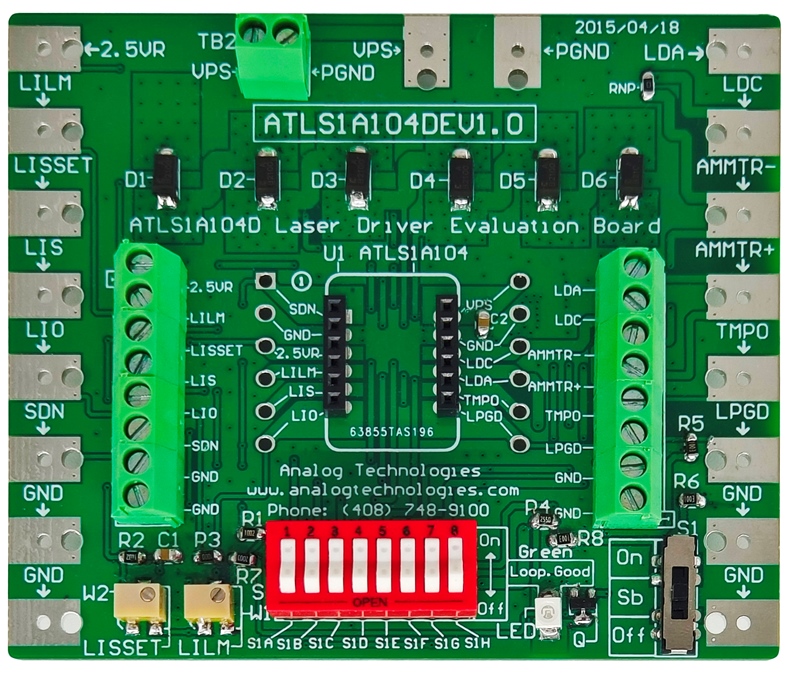
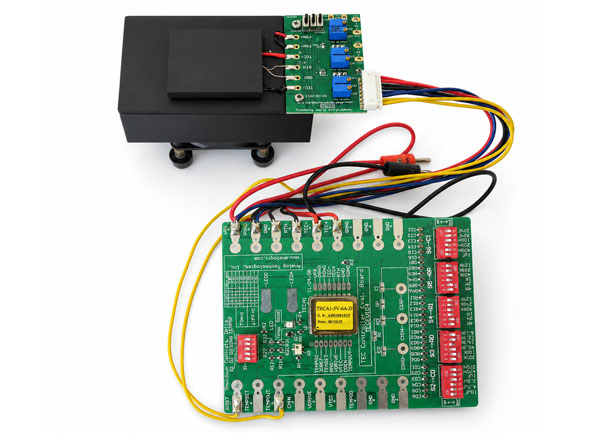
TECEV104 is the workhorse evaluation board for the TECA1, TEC5V4A-D, and TEC5V6A-D analog controller series. It provides a complete tunable compensation network, output-voltage limit control, set-point temperature potentiometer, temperature-loop-status LED, and numerous solder/probe pads for instrument hookup. TEC14MEV1.0 (140×130 mm) is the dedicated eval board for the micro TEC14M5V3R5AS. TEC24V15AEV2.2 is the new universal evaluation board for the entire TEC28V15A / TEC24V10A / TEC18V15A / TEC12V9A / TEC9V7A high-power family — supports thermistor (NTC) / RTD / IC temperature sensors with selectable CW or sample-and-hold thermistor mode, tunable compensation network (RP / RI / RD / CI / CD), and replaces the legacy TEC28V15AEV1, TEC28V15AEV2, and TECEV103.
Universal eval board for TEC28V15A / TEC24V10A / TEC18V15A / TEC12V9A / TEC9V7A series. Replaces TEC28V15AEV1, TEC28V15AEV2, and TECEV103.
$25
Engineering FAQ
Frequently Asked Questions — TEC Controllers & Peltier Temperature Control
How does a Thermoelectric Cooler (TEC) work?
A TEC, also called a Peltier cooler, is a solid-state heat pump that moves heat from one of its ceramic faces to the other when DC current flows through it. Internally it consists of an array of n-type and p-type bismuth-telluride elements connected electrically in series and thermally in parallel between two ceramic plates. Reversing the current direction reverses the hot and cold faces, so the same TEC can both cool and heat the same object — perfect for tight temperature regulation around ambient. Cooling capacity scales with current; the temperature differential ΔT scales with voltage.
How does a TEC controller work?
Every TEC controller has four critical circuit blocks: (1) a temperature-sensing front end that reads an NTC thermistor or RTD and converts resistance to voltage, (2) an error amplifier that compares the actual-temperature voltage against the user set-point, (3) a thermal-loop compensation network that shapes the loop response to match the thermal load's time constants, and (4) an H-bridge output stage that drives both current direction and magnitude into the TEC. The compensation network is the trickiest block to get right and is what separates an off-the-shelf controller from a tuned production-ready system.
What makes ATI's TEC controllers different from competitors?
ATI's output H-bridge uses only one PWM engine where conventional designs require two (U.S. Patent 6,486,643 B2). This patented architecture delivers 20% lower power loss, 25% lower bill-of-materials cost, and 35% less PCB area than competitor designs at the same current rating. Combined with gold-coated grounded metal shielding (zero EMI ingress / egress) and full vacuum potting (consistent thermal conduction, vibration- and shock-tolerant — flight-grade), our controllers achieve high efficiency, high stability, small size, and low cost simultaneously.
Are ATI's TEC controllers shielded and EMI-compliant?
Yes. All standalone analog controllers (TEC5V4A-D, TEC5V6A-D, TECA1 family) ship in a gold-coated grounded metal enclosure that fully shields against EMI in both directions — preventing the controller from radiating noise into adjacent precision electronics, and at the same time protecting the controller's internal loop from external interference. The enclosures are fully vacuum-potted for consistent thermal conduction and mechanical robustness, suitable for space and avionics applications.
Do you offer SMT (surface-mount) packages?
Yes — several controller families have an SMT option (TEC28V15A / TEC18V15A series SMT variants), and the Micro TEC controller (TEC14M5V3R5AS) is SMT-only. That said, for highest reliability and thermal dissipation we recommend the DIP package wherever board space allows — SMT slightly reduces reliability and limits the heat-sinking path because the package no longer makes direct contact with a metal case. The TEC14M5V3R5AS works around this with a dedicated bottom thermal pad.
What's the difference between TECA1-xV-xV-D and TECA1-xV-xV-DAH?
Same DIP footprint and 2.5 A max current, but the -DAH variant tightens the temperature offset between actual and set-point by a factor of 25 — from ±0.1°C (15 mV) down to ±0.004°C (0.5 mV). For typical laser-diode temperature control, the -D is fine. For narrow-linewidth wavelength locking, atomic frequency references, or wavelength-stabilized DWDM transceivers, choose -DAH. The -DAH also adds an actual-object-temperature monitoring output (V_TEMP) for closed-loop logging.
What does the 'LD' in TECA1LD-… mean?
'LD' means the on-board compensation network is pre-tuned for typical laser-diode thermal loads (the most common TEC application). Choose the LD variant to skip the compensation-tuning step during prototyping; choose the non-LD variant if your thermal load is unusual (large mass, slow thermal time constant, or very small TEC) and you'll tune the compensation network yourself on the evaluation board.
How long is the warranty on ATI TEC controllers?
30 days unconditional return / exchange (excluding custom-designed products) — within 30 days of purchase you can return for refund or exchange for any other product. 10 years conditional replacement — within 10 years from the date of purchase, we replace any unit that fails due to manufacturing defect, provided it was used within spec. Send the failed unit back for free replacement.
Why does my object temperature oscillate or take too long to settle?
The most common cause is a compensation network mismatched to the thermal load's characteristics. Symptoms: the voltage across the TEC oscillates up and down, or the polarity toggles repeatedly, and the system never settles. The fix is to tune the compensation network on the evaluation board (TECEV104 for TECA1/TEC5V4A/TEC5V6A series, TEC24V15AEV2.2 universal eval board for the high-power family) while watching the actual-temperature trace until it converges critically-damped to set-point. If instead the voltage across the TEC stays pinned at maximum without oscillation, your TEC's cooling power is simply too low for the thermal load — upgrade to a larger TEC module.
What is the best way to fine-tune the compensation network?
Use the evaluation board (TECEV104 for the analog series, TEC24V15AEV2.2 for the high-power family). The board has an adjustable compensation network with pots/switches, letting you sweep the loop response while monitoring the actual-temperature trace. Tune for a slightly under-damped step response (~5% overshoot, no ringing) for the fastest settling without instability.
Can I get a TEC controller with auto-PID firmware so I don't have to tune?
Yes — the entire TEC28V15A / TEC24V10A / TEC18V15A / TEC12V9A / TEC9V7A high-power family ships with embedded auto-PID firmware that self-tunes against the thermal load, no manual compensation-network tuning required. If your thermal load is unusual or the auto-PID settles too slowly, you can still fall back to the traditional analog compensation pins and tune manually. The digital ATFC106D chamber controller also includes embedded firmware.
Are these RoHS and REACH compliant?
All ATI TEC controllers are 100% lead-free, RoHS-compliant, and REACH-compliant. RoHS and REACH certificates of compliance are linked at the bottom of this page.