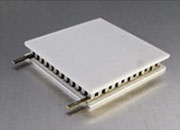
A piezo amplifier is a high-voltage, signal-controlled power amplifier that converts a low-voltage command (0–5 V or ±10 V) into a precise high-voltage drive waveform — up to ±2 kV — for a capacitive piezoelectric actuator. It supplies not just the voltage the actuator needs to move, but the current required to charge and discharge its capacitance at the commanded speed. Select one by voltage alone and it may be useless for fast motion.
A piezo actuator behaves electrically as a capacitor whose displacement is proportional to applied voltage. Picture an elevator: voltage is the floor you want (how far the actuator moves), and current is the motor horsepower that gets you there (how fast). A weak motor still reaches the top floor — eventually. The signal chain inside the amplifier is: command input → gain stage (20×–200×) → power stage that sources and sinks capacitive current → output filter → protection, with optional strain-gauge or capacitive feedback in closed-loop systems.
Voltage sets the available stroke, but current and speed decide whether the actuator can follow the waveform. For a capacitive load the required current is I = C × dV/dt; for a sinusoidal drive, I_peak = 2π × f × C × V_peak. A 1 µF actuator at 500 V peak needs ~314 mA at 100 Hz — but 3.14 A at 1 kHz. Frequency changes everything.
| Requirement | Why it matters | Design question |
|---|---|---|
| Output voltage range | Sets available piezo stroke | What voltage does rated displacement need? |
| Output current | Charges/discharges the capacitance | Can it supply peak AND RMS current at your waveform? |
| Slew rate / bandwidth | Determines waveform fidelity | Can the output move fast enough across full swing? |
Bandwidth is the small-signal speed limit; slew rate is how fast the output can actually change voltage at full swing (minimum transition t_min ≈ ΔV/SR). For large piezo strokes, slew rate is usually the bottleneck before bandwidth ever matters — verify both. ATI's high-speed bipolar family is the sports car of the line:
| Family | Slew rate | Bandwidth | Output range |
|---|---|---|---|
| AHVAPN (high-speed bipolar) | 2000 V/µs | Up to 15 kHz | ±1 kV to ±2 kV |
| AHVA2KV2X | 150 V/µs | Up to 10 kHz | 10 V to 2 kV |
| AHVA1KV2X | 100 V/µs | Up to 10 kHz | 10 V to 1 kV |
| AHVA500V2X | 100 V/µs | Up to 10 kHz | 10 V to 500 V |
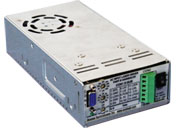
ATI integrates everything into a single shielded module — no external high-voltage supply, no external HV wiring hazard:
• Built-in HV DC-DC converter — just connect 24 V; it generates the high voltage internally.
• Precision gain stage — low noise (400 µVp-p @ 0.1–10 Hz on AHVAPN), low drift.
• Linear power output stage — sources and sinks capacitive current smoothly.
• Full protection suite — UVLO, OVLO, over-temperature shutdown, soft start, output current limit, and ESD clamping. A piezo stack can cost $500–$5,000; protection is insurance against destroying it.
| Application need | Typical requirement | ATI starting point |
|---|---|---|
| High-speed bipolar scanning | ±1–±2 kV, 2000 V/µs | AHVAPN series |
| Positive-output stack drive | 10 V–2 kV, 5–20 mA | AHVA2KV2X |
| Mid-voltage actuator drive | 10 V–1 kV, 5–20 mA | AHVA1KV2X |
| Lower-voltage, higher-current | 10 V–500 V, 5–50 mA | AHVA500V2X |
| Benchtop lab testing | AC input, 0–2 kV, instrument-style | ATI242000A |
| Large-capacitance + waveform gen | Up to 100 µF, −30 to 300 V | APZD300V2A |
| Board-level HV op-amp integration | Up to 1500 V, 100 mA | AHVOA1500V100MA |
Common applications: nanopositioning stages, fast scanning mirrors and galvos, piezo valves and inkjet dispensers, active vibration cancellation, confocal/AFM focus, ultrasonic transducer drive, semiconductor test, optical-fiber alignment, and adaptive-optics deformable mirrors. See the full piezo driver / high-voltage amplifier line.
• Integrated HV supply — no external high-voltage power supply; just 24 V in.
• Full protection — UVLO, OVLO, OTP, soft start, current limit, ESD.
• Ultra-low noise — 400 µVp-p @ 0.1–10 Hz (AHVAPN family).
• High slew rate — up to 2000 V/µs; wide range from 100 V to ±2 kV.
• Compact modules — drop-in PCB mounting, no bench instruments needed.
• Since-1997 continuity — no model ever discontinued; same-day shipping from San Jose and direct support from the designers.
Is a piezo amplifier the same as a high-voltage power supply? No. A power supply provides static DC bias; a piezo amplifier follows a dynamic command waveform and must both source and sink capacitive current as the actuator charges and discharges.
Why does capacitance matter so much? Because I = C × dV/dt. At the same speed and voltage, a 10 µF actuator needs 100× the current of a 0.1 µF actuator.
What matters more — bandwidth or slew rate? Both. Bandwidth is small-signal frequency response; slew rate is large-signal voltage transition speed. For large strokes, slew rate usually dominates.
Can I select a piezo driver by voltage alone? Never. Voltage sets stroke, but current and speed determine whether the actuator can follow your waveform.
Do ATI amplifiers need an external high-voltage supply? No — every ATI module includes a built-in HV DC-DC converter. Just connect 24 V.
Related: High-Voltage Amplifier / Piezo Driver · AHVA2KV2X (2 kV) · AHVA1KV2X (1 kV) · AHVA500V2X (500 V) · Benchtop ATI242000A · APZD300V2A · AHVOA1500V100MA · White Papers · Contact