A
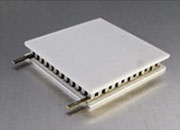
thermoelectric cooler (TEC), also called a
Peltier module, is a compact solid-state heat pump — no compressor, no refrigerant, no moving part in the cooling element. With a matched
TEC controller, sensor, heat sink, and mounting stack, it becomes a bidirectional thermal actuator that can cool below ambient, heat above it, and hold a high-value device at a stable setpoint. The core idea is simple:
a TEC moves heat; it does not make heat disappear.
Download the full white paper (PDF)
AWPTM-05 · 8 pages · physics, selection tables, controller architecture, and a design-review checklist
Download PDF ↓
1. The core rule: the hot side determines the cold side
When DC current flows, the Peltier effect absorbs heat on the cold side and rejects it on the hot side; reversing current reverses the direction. But the TEC's own electrical input power also turns into heat that the hot side must reject. The most important practical equation is:
Qh = Qc + Pin
hot-side heat to reject = load heat absorbed + electrical input power
The heat sink, fan, cold plate, thermal interface, enclosure airflow, and ambient must remove Qh — not just the load heat Qc. Example: remove 18 W from a laser package while the TEC draws 35 W, and the hot side must reject roughly 53 W before driver and interface losses and safety margin. If that heat can't leave, the hot side warms, the cold side rises, and more drive current can make things worse, not better.
| Effect |
What it does |
| Peltier pumping | Transfers useful heat from the cold side to the hot side. |
| Joule heating | Loss heat from current through the legs, interconnects, and solder. |
| Back-conduction | Heat leaks hot-to-cold as the temperature difference grows. |
These act at once, which is why maximum current is not automatically the best operating point.
2. Selection: evaluate at the real operating point, not Qmax
Cooling capacity falls as the required delta-T rises. The catalog Qmax is usually quoted at delta-T = 0 and does not represent your useful capacity at the real operating temperature difference. Define requirements first; finalize ratings second.
| Selection factor |
Question to ask |
Recommended action |
| Heat load Qc | What must be removed (conduction, convection, radiation, self-heating)? | Build a heat budget with margin for ambient extremes. |
| Operating delta-T | What hot-side temperature is realistic after the sink warms up? | Check capacity at the real hot-to-cold difference. |
| Mechanical envelope | Are cold plate, ceramic area, lead exit, and clamping compatible? | Don't use the ceramic plates as structural members. |
| Thermal cycling | Will it repeatedly cross wide temperature ranges? | Choose a cycling-capable family (e.g. TC / TCHE) when the duty cycle is severe. |
| Condensation risk | Will the cold side fall below dew point? | Seal, insulate, and protect electronics from moisture. |
Start from the
ATI TEC modules family: standard, high-temperature, circular, and the TC / TCHE series for thermal-cycling reliability.
| Application |
Challenge |
TEC approach |
| Laser diode wavelength stabilization | Wavelength/output drift with junction temperature | Sensor near the package, bidirectional current, low ripple, hot-side sized for worst ambient. |
| Optical detector / camera cooling | Dark current and thermal noise limit sensitivity | Local cooling, insulation, moisture control, low-noise driver, stable feedback. |
| PCR / lab-on-a-chip cycling | Fast, repeatable, uniform temperature transitions | Cycling-capable module, low thermal mass, controlled ramp rates, reliable clamping. |
| Semiconductor test stage | Programmable hot/cold/transition conditions | TEC stage + heat spreader + calibrated sensor + controller with stable limits. |
Design-review question: which temperature does the product actually need to control? Heat-sink, PCB, enclosure-air, ceramic-plate, and laser-junction temperatures are not the same variable. If the sensor isn't where performance is determined, the loop can be perfectly stable while regulating the wrong thing.
4. The TEC controller: precision, ripple, EMI, compensation
A module is only the actuator. Precision control needs a sensor at the object, a stable compensation network, a controlled-current power stage, current/voltage limits, defined start-up and fault behavior, and a loop that stays stable as the thermal load changes.
| Controller topic |
Why it matters |
| Bidirectional current | The same TEC must heat or cool around the setpoint. |
| Low ripple / EMI | Ripple reduces effective COP and disturbs optical and analog electronics. |
| Compensation / PID | Thermal plants are slow, nonlinear, load-dependent; matched or auto-tuned loops shorten development. |
| Protection limits | Overcurrent, overtemperature, sensor fault, and start-up behavior affect reliability. |
| Sensor compatibility | NTC, RTD, and IC sensors align type with system accuracy and cost. |
For a compact precision starting point, see the
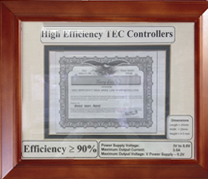
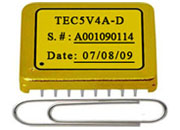
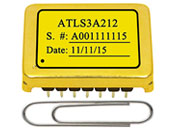
TECA1 Series TEC controllers — high-efficiency topology, precision object-temperature monitoring, high stability, and shielded low-EMI construction, which matters when the controller shares an enclosure with laser drivers, photodiode amplifiers, or ADCs.
5. Reliability and mounting
Solid-state does not mean abuse-proof. Reliability depends on flatness, clamping force, interface thickness, moisture sealing, hot-side temperature, cycling amplitude, current, ramp rate, and mechanical strain.
• Use flat plates, cross-pattern torque, and controlled compression — uneven clamping cracks ceramics or raises thermal resistance.
• Don't use the module as a structural support; prevent sliding and cable strain (limited shear tolerance).
• Below dew point, insulate, vapor-seal, and apply conformal protection; do a dew-point analysis.
• Size the heat sink for Qh, verify airflow, and use controller limits to cap hot-side temperature.
• For severe cycling, pick a cycling-capable family and manage ramp rates (CTE mismatch fatigues solder).
• Drive with a low-ripple, shielded controller to avoid wasting capacity and disturbing nearby analog circuits.
Use this paper as a design-review guide
Full physics, figures, comparison and selection tables, and the 8-item review checklist are in the PDF
Download full PDF ↓
ATI offers TEC modules, TEC controllers, and laser-temperature-stabilization products as one ecosystem, matched to your heat load, operating delta-T, sensor, control bandwidth, EMI environment, and reliability target.