A railway lantern is a purpose-built portable safety-lighting device designed for railway operations, track inspection, visibility support, maintenance, and emergency response. It is evaluated primarily on work-shift runtime, be-seen visibility, ergonomic balance, and rugged handling — not on peak brightness alone.
The ATI RWLT101 is a patented, rechargeable LED railway lantern with a 15 Ah internal battery, up to 12 hours of continuous operation, less than 3 hours full recharge, a large front-reflector assembly (~90 mm reflective-metal inner / ~100 mm overall including plastic), an auxiliary side beam, a real-time status display, a Type-C charging input, and a USB output (2 A max) — each performance figure stated per the RWLT101 datasheet under its stated conditions.
The RWLT101 is portable illumination and visibility support only. It is not a certified railway signaling device and is not a substitute for required railway signals, PPE, procedures, or approved safety equipment. Refer to the current RWLT101 datasheet and applicable local rules before deploying to any specific application.
A railway lantern is a purpose-built portable lighting tool for railway operations, track and infrastructure inspection, visibility support, yard operations, maintenance work, emergency response, and other low-light outdoor environments. The form factor is designed around visibility, grip stability with gloves, orientation, runtime, and ruggedness — not pocket carry.
In modern railway work the operator needs to both see the ground and be seen — by crew members, locomotive engineers, and equipment operators. Contemporary railway lanterns use high-efficiency LED sources and rechargeable batteries, but the underlying requirement is unchanged: dependable light in the operator's hand when the environment is dark, moving, wet, or otherwise hard to control.
Battery capacity & continuous working time · charging time & interface (USB Type-C) · main-beam range and beam pattern (reflector diameter + LED efficiency) · side / auxiliary lighting for be-seen visibility · ergonomic balance (where the CG sits relative to the grip axis) · handle geometry & carrying methods · real-time status feedback · thermal design (LED junction temperature drives service life) · auxiliary USB utility · datasheet, parts & warranty support.
A consumer flashlight is optimized for one thing: a compact, hand-held directional beam. Railway and maintenance work typically requires a broader set of functions during a single shift — long runtime, stable grip with gloves, side visibility, quick hanging or set-down, high-capacity battery storage, real-time status, and the ability to illuminate an area while the worker keeps moving. The two products solve different problems, and should be evaluated against different criteria.
| Buyer requirement | Regular-flashlight limitation | Railway-lantern design need |
|---|---|---|
| Full-shift operation | Optimized for short or intermittent use. | Large battery capacity, predictable continuous working time. |
| Be-seen visibility | Narrow forward beam — not visible from the side. | Main beam plus side / auxiliary beam for area awareness. |
| Gloved handling | Small cylindrical body is tiring or slippery. | Large handle, balanced grip, multiple carrying methods. |
| Status awareness | Little or no runtime / battery feedback. | Digital display shows remaining runtime, charge / discharge current, and remaining capacity in real time. |
| Thermal / service duty | May overheat under long continuous use. | Metal heatsink and thermal path designed for extended runtime. |
| Weather / water ingress | Often not waterproof; frequently no formal IP rating. | Sealed enclosure rated for temporary water immersion (see datasheet for rated depth, duration, orientation, test method). |
| Emergency SOS signal | No dedicated signaling mode. | Built-in one-touch SOS flashing mode for an incident or breakdown. |
The most under-appreciated specification on any hand-carried tool is the location of its center of gravity (CG) relative to the grip axis. Two identical lanterns of the same mass can feel dramatically different in the hand depending only on where their CG sits.
Static wrist moment. When the CG is offset horizontally from the grip axis by a distance d, gravity applies a static torque on the wrist: τwrist = m · g · d. Holding the lantern level requires the forearm to generate an equal and opposite counter-torque continuously. Even though this produces no mechanical work (the lantern does not move), sustaining it draws real metabolic effort. Over a multi-hour shift, this sustained holding-torque is what makes a lantern feel far heavier than its actual mass would suggest. Minimize d by placing the heaviest component (the battery) at the grip axis, and τwrist is minimized with it.
Pendulum motion during walking. Modeled as a simple pendulum pivoting at the grip, the natural period is Tp = 2π · √(L/g), where L is the vertical distance from the grip to the CG. Placing the CG near the grip axis (small L) reduces the moment arm each footstep excites, so beam wander is reduced — the lantern behaves closer to a balanced load than a free pendulum. (Actual oscillation amplitude depends on gait, arm damping, and carry method, and is not predicted by Tp alone.)
Runtime arithmetic. A first-order estimate is trun = Cbatt / Iavg. Applied to the RWLT101 — 15 Ah nominal capacity at a typical main-beam load — this yields the datasheet figure of up to 12 hours of continuous operation (per RWLT101 datasheet under stated conditions). Treat any single number as an upper-bound reference; actual runtime depends on temperature, brightness setting, and side-beam use.
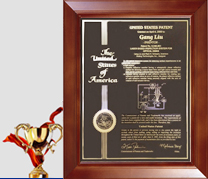
Patented architecture — battery in the handle. Most conventional railway lanterns put the rechargeable battery pack in the lantern body, below the handle. The RWLT101 hides the battery cell(s) inside the C-shaped handle itself, placing the center of mass of the assembled lantern within the curved handle. This is the essence of the patented design: it puts the CG close to the grip axis, so the static wrist moment and the pendulum swing during walking are reduced relative to body-battery designs. In ATI's market review, ATI has not identified another railway lantern using this same battery-in-handle, center-of-mass-within-handle architecture; the controlling scope is defined by the issued patent claims of U.S. Patent No. 11,859,781 B1 (Liu et al., issued January 2, 2024; assignee Analog Technologies, Inc.).
The direct-ventilated metal-reflector heatsink is a supporting RWLT101 design feature, not a patented element. The controlling scope of U.S. Patent No. 11,859,781 B1 is defined solely by the issued claims — the patented architecture is battery-in-handle with center-of-mass-within-handle. Readers evaluating patent applicability must refer to the issued patent text.
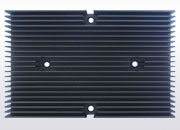
Supporting feature — direct-ventilated metal LED heatsink. The RWLT101 uses a real, large-diameter metal reflector (~90 mm reflective-metal inner diameter; ~100 mm overall front-assembly diameter with the plastic rim) that also serves as the main-LED heatsink, ventilated directly to ambient air through side vents. Junction-temperature control drives both LED efficiency and long-term lifetime (typical > 5 years per RWLT101 datasheet under stated conditions). Many conventional body-battery designs reviewed by ATI do not include a comparable dedicated heatsink or direct ambient ventilation, so their LED runs hotter than it needs to. The RWLT101 addresses this at the mechanical level rather than by throttling the LED — which is how the datasheet can support both a large ~4-inch-class front reflector and a > 5-year typical LED lifetime under stated conditions.
The features below are drawn from the ATI RWLT101 datasheet and product page. Buyers should verify current specifications against the latest datasheet at time of order.
| Specification | ATI RWLT101 | Why it matters to buyers |
|---|---|---|
| Battery | Built-in rechargeable, 15 Ah | Supports long work periods and repeated field use. |
| Cycle life | > 2,000 recharge cycles | Reduces disposable-battery cost and replacement downtime. |
| Continuous working time | Up to 12 hours | Supports overnight or full-shift use under the datasheet's stated load. |
| Charging | Type-C input, < 3 hours full charge | Modern, widely-available interface; fast shift turnaround. |
| Main optical system | High-efficiency LEDs, front-reflector assembly (~90 mm reflective-metal inner / ~100 mm overall incl. plastic) | Forward illumination and beam control. |
| Auxiliary lighting | Side / auxiliary beam | Side visibility and area lighting. |
| Display | Real-time runtime, charge / discharge current, battery % | Plan remaining work time instead of guessing. |
| Brightness | Programmable / user-configurable output | Balance runtime against required brightness. |
| Emergency signaling | Built-in one-touch SOS flashing mode | Dedicated emergency signal without improvising (visibility-support only). |
| Device charging | USB output, 2 A max | Emergency utility beyond illumination. |
| Thermal design | Metal reflector acts as heatsink, ventilated to ambient air; typical LED life > 5 years | Manages LED heat and extends service life. |
| Mechanical handling | Weight-balanced C-shaped handle, hook, bumper, shoulder-strap holes | Supports hand, arm, hook, and shoulder-strap carry. |
| Environmental sealing | Sealed for temporary water immersion (see datasheet) | Confirm rated depth, duration, orientation, and test method on the datasheet. |
| Intellectual property | U.S. Pat. No. 11,859,781 B1 (Jan. 2, 2024) | Verified IP for RFQs, distributor listings, and competitive positioning. |
Every performance figure is stated per the RWLT101 datasheet under its stated conditions. Specifications are subject to change without notice.
The RWLT101 fits any team that needs long-runtime portable lighting with real-time status feedback:
How is a railway lantern different from a regular flashlight?
A flashlight provides a single forward beam in a compact body. A railway lantern is designed for longer runtime, easier gloved handling, side visibility, stable carrying or hanging, and clear battery feedback for field work.
What does "weight-balanced" mean — and why does it matter?
The rechargeable battery cell(s) are integrated inside the C-shaped handle instead of the lantern body, so the center of mass sits within the handle. Compared with body-battery designs, the sustained wrist holding-torque is reduced and the pendulum swing during walking is lower (mechanical effect; individual ergonomic outcomes will vary).
Is the RWLT101 waterproof / IP-rated?
The enclosure is sealed for temporary water immersion under the RWLT101 datasheet's stated conditions (rated depth, duration, orientation, test method). It is not qualified for continuous submersion, pressure washing, or chemical exposure. Confirm the exact rated conditions on the current datasheet.
Is the LED brightness specified in lumens?
The RWLT101 is currently specified by reflector size, LED efficiency class, runtime, and beam configuration. If a lumen rating is required for your bid, request the latest RWLT101 datasheet to confirm the current published number.
Is there a US patent covering the design?
Yes — U.S. Patent No. 11,859,781 B1, issued January 2, 2024 (inventors Gang Liu, Lili Shi, Yuqi Zhang, Nan Shi; assignee Analog Technologies, Inc.). Application No. 17/818,358, filed August 8, 2022, with 19 claims and 21 drawing sheets. The claim scope covers a portable illumination device whose center of mass is located within the curved handle that also contains the battery cell(s).
Applications engineering can review qualified projects and confirm current specifications. Always check the latest datasheet and product page before placing an order.
Download White Paper (PDF) ↓ RWLT101 Product Page Order OnlineWhite Paper AWP-RWLT-01 · Rev. 1.9 · July 2026
Analog Technologies, Inc. · San Jose, California · www.analogtechnologies.com
Sales: sales@analogti.com · Contact ATI · Copyright © 1997–2026 Analog Technologies, Inc. All rights reserved.
This white paper is a product-selection and marketing-support document. It is not a railway operating rule, signaling standard, or safety-certification document. The RWLT101 is portable illumination and visibility support only and is not a substitute for required railway signals, PPE, procedures, or approved safety equipment.