Laser Drivers: The Quiet Engine Behind Every Great Laser System
Time : Apr 03 2026Source :未知 Author : Fang Click :
Laser Drivers: The Quiet Engine Behind Every Great Laser System
Why the driver matters more than most engineers expect — and how to choose one that won't let you down
1. The Most Underrated Component in Your Laser System
When engineers design a laser-based system, most of the attention goes to the laser diode itself — its wavelength, output power, beam quality, and lifetime. The laser driver, by contrast, tends to be treated as an afterthought. Specify a current, pick a module off the shelf, move on.
That is a mistake that shows up later, usually at the worst possible time.
The laser driver is the component that determines how cleanly and stably current reaches the laser diode every single millisecond of operation. It governs whether the output power drifts over temperature, whether a startup transient damages an expensive diode, and whether low-frequency noise buries the signal you are trying to measure. In precision systems — spectroscopy, sensing, coherent communication, medical diagnostics — the driver is not behind the scenes. It is right at the center of every performance trade-off.
Think of the laser driver the way a musician thinks of the amplifier. The instrument may be extraordinary, but a noisy, unstable amplifier will ruin the performance every time.
2. What Laser Diodes Actually Demand from Their Driver
Laser diodes are sensitive in ways that are easy to underestimate. A laser diode is not a resistor — it is a p-n junction with a sharply nonlinear voltage-current characteristic, a strong temperature dependence, and essentially no tolerance for transient abuse.
Current, Not Voltage
Laser diodes must be driven by a controlled current source, not a voltage source. Because the forward voltage varies with temperature, a fixed voltage supply will cause the current — and therefore the optical output power — to drift as the device warms up. A well-designed constant-current driver eliminates this drift. ATI laser drivers are engineered to maintain output current stability to better than +/-0.5 mA across a 30°C to 60°C operating range, regardless of load variation.
Noise: Smaller Than You Think, More Damaging Than You Expect
The noise floor of a laser driver is typically measured in microamps. In optical sensing and spectroscopy, current noise translates directly into optical power noise and phase noise. ATI's ATLS500MA104 achieves less than 0.6 uARRMS at 0.1 Hz to 10 Hz — roughly an 8x improvement over a 5 uAP-P specification.
The Startup Transient Problem
Most laser diode failures in the field are caused by startup transients — brief current spikes in the first microseconds after power is applied. ATI laser drivers include soft-start circuitry that ramps the output current gradually at power-on, completely eliminating these startup events.
3. What Separates a Good Laser Driver from a Great One
Output Noise
ATI's laser driver families span two noise tiers:
• ATLSxA104 series: < 0.6 uARRMS @ 0.1 Hz to 10 Hz
• ATLSxA103 series: <= 5 uAP-P @ 0.1 Hz to 10 Hz
• Available currents: 100 mA, 250 mA, 500 mA, 1 A, 1.5 A
• Applications: DPSSL, EDFA, SOA, fiber laser, sensing
EMI Shielding: The 6-Sided Metal Enclosure
ATI laser drivers are housed in a 6-sided gold-coated metal enclosure that blocks EMI in both directions: it keeps outside interference from getting in, and prevents the driver's own switching activity from radiating out.
Modulation Bandwidth and Response Time
ATI's 104-series drivers provide a large-signal modulation bandwidth of 4.67 MHz with 75 nS rise and fall times, controlled via a simple 0 V to 2.5 V analog input.
Monitoring and Control
Every model in the 103 and 104 series provides:
• LIO — Laser current output indication: a 0 V to 2.5 V analog output that tracks actual output current in real time.
• LPGD — Loop good indicator: a digital output that goes high when the control loop is closed and the actual current equals the set-point.
• TMPO — Temperature monitor output: an analog output proportional to the driver's internal temperature.
• SBDN — Three-state control (104 series): a single pin that selects shutdown, standby, or full operation mode.
Compact Size
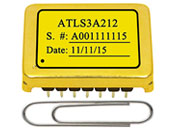
The entire ATI 103 and 104 series fits in a DIP package measuring just 20 x 14.5 mm, 5 mm thick. An SMT version is also available for even tighter integration.
4. Protection That Actually Protects
ATI laser drivers implement protection at multiple levels:
• Independently programmable current limit via a dedicated LIMS pin (0 V to 2.5 V).
• Soft-start: output current ramps up gradually from zero at every power-on event.
• Over-temperature shutdown at 120 degrees C, with automatic restart after cooling.
• 2.5 V precision internal voltage reference on the 2.5VR pin for external DACs and ADCs.
5. A Driver for Every Application
Analog Technologies has been developing laser driver solutions since 1997. The product range covers:
• ATLSxA104: Ultra-low noise < 0.6 uARRMS, VPS 3.1-5.5 V, up to 1.5 A
• ATLSxA103: Low noise <= 5 uAP-P, 1 MHz bandwidth, up to 1 A
• ATLSxA106: Extra-low noise, 5 V supply, 250 mA and 500 mA
• ATLSxA212/214/216: High voltage, multi-diode arrays, up to 6 A
• ATLSxA116: High voltage low noise, 1 MHz bandwidth, up to 1 A
• ATLSxA118: Wide input 10-28 V, ultra-low noise, up to 10 A
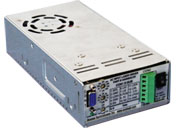
• AAS series: AC input laser power supplies, up to 45 A
• Pulse mode drivers: Peak currents 10 A to 200 A, pulse widths 5 nS to 10 uS
6. Where ATI Laser Drivers Are Used
• Fiber optic communication: pump laser drivers for EDFAs and SOAs in long-haul and metro networks.
• Optical sensing and LIDAR: constant-current drive for CW and pulsed laser sources.
• Spectroscopy and chemical analysis: precision low-noise current control for TDLAS, Raman excitation, and fluorescence instruments.
• Medical and biomedical: laser illumination for surgical systems, imaging, and phototherapy equipment.
• Semiconductor testing: driving probe lasers and alignment sources in wafer inspection systems.
• Scientific research: stabilizing laser diodes in atomic physics, quantum optics, and precision metrology.
• Industrial processing: driving high-power diode arrays for marking, cutting, soldering, and curing.
7. Why Engineers Keep Coming Back to Analog Technologies
ATI was founded in 1997 with a focus on analog and mixed-signal electronics for laser, thermal, and power control applications. The result is a product line that reflects nearly 30 years of iterative improvement on a narrow, well-understood problem: how to deliver precise, stable, low-noise current to a laser diode, reliably, in a compact package.
Every ATI laser driver datasheet lists real, tested specifications with test conditions clearly stated. The noise numbers are measured noise, not marketing claims. The protection features are implemented in hardware. The monitoring outputs are calibrated analog signals.
8. Finding the Right Driver for Your Application
Selecting the right laser driver starts with four questions:
• What is the required output current? ATI offers drivers from 50 mA to 200 A.
• What noise floor does the application require? For sensing and spectroscopy, the 104-series (< 0.6 uARRMS). For less noise-sensitive applications, the 103-series (<=5 uAP-P).
• What is the available power supply voltage? Options span from 3.3 V up to 28 V.
• Is modulation required? 104-series: 4.67 MHz; 103-series: 1 MHz; 116-series: 1 MHz at high voltage.
Resources: analogtechnologies.com/laserdriver.html | shop.analogtechnologies.com
Conclusion: The Driver Is the Difference
The laser diode gets the credit. The driver does the work.
ATI laser drivers are designed by engineers who understand this problem deeply, and who have spent decades refining solutions that work in real products, in real environments, at real temperatures. The noise specs are real. The protection features work. The monitoring outputs tell the truth.
Start at www.analogtechnologies.com
Contact: 1161 Ringwood Ct., #110, San Jose, CA 95131, U.S.A. | Tel: 408-748-9100 | www.analogtechnologies.com