Driving Ionizing Loads with High Voltage Power Supplies
Using a Series Resistor to Limit Peak Current During Arc and Spark Events
1. Introduction
High voltage power supplies (HVPS) are used extensively in applications where air ionization is intentional - including electrostatic precipitators, corona discharge devices, air ionizers, ozone generators, and plasma systems. In all of these, the load can periodically present a near-short-circuit to the power supply when the surrounding air breaks down and conducts a spark or arc.
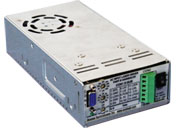
ATI offers a comprehensive family of HVPS modules with outputs from 100 V to 50 kV, featuring ultra-low ripple (< 0.02% RMS), high efficiency (>90%), galvanic isolation, and built-in arc protection. Despite this built-in protection, an external series resistor between the module output and the ionizing load is the simplest and most reliable way to limit peak current during arc events and prevent damage to the power supply.
2. Why Arcs Are Dangerous to the Power Supply
Under normal conditions an ionizing electrode presents an impedance of 10 MΩ to 1 GΩ. However, when the electric field exceeds the breakdown strength of air (~30 kV/cm), a spark occurs and the load impedance collapses to near zero in nanoseconds. Without a current-limiting element, the peak surge current can far exceed the HVPS rated maximum, stressing or permanently damaging output rectifiers, filter capacitors, and transformer windings. Repeated arc events without protection significantly shorten the service life of the power supply.
Key ionizing-load characteristics relevant to protection design:
3. Circuit Solution: Series Resistor
Inserting a high-voltage resistor Rs in series between the HVPS output and the ionizing load imposes a hard upper limit on the peak current during any arc event. Under normal high-impedance operation the voltage drop across Rs is negligible. An optional bypass capacitor C placed directly in parallel with the load acts as a local energy reservoir, sustaining the discharge without disturbing the HVPS and filtering arc noise from propagating back into the supply.
Figure 1. Series-Resistor Protection Circuit. The current enters the ionizing load from the top and exits from the bottom. Capacitor C is connected in parallel with the load.
4. Mathematical Analysis
4.1 Steady-State Current
Because Rs << RL, virtually the full supply voltage V0 appears across the load. Steady-state current and voltage drop across Rs:
Iss = V0 / (Rs + RL) ≈ V0 / RL ; VRs(ss) = Iss × Rs (1)
The voltage drop across Rs at steady state is typically less than 1% of V0.
4.2 Peak Current During an Arc - Key Design Equation
During an arc, RL ≈ 0 and Ctotal discharges through Rs. The instantaneous peak current is:
Ipeak = V0 / Rs (2)
To guarantee Ipeak ≤ Imax with a 20% design margin:
Rs ≥ V0 / (0.8 × Imax) (3)
4.3 Energy and Time Constant per Arc Event
Energy discharged through Rs per arc, and the exponential discharge / recharge time constant:
ERs = 1/2 × Ctotal × V02 ; τ = Rs × Ctotal ; i(t) = Ipeak × e-t/τ (4)
Recharge to 99% of V0 takes ≈5τ. For arc repetition rate f, ensure 5τ < 1/f.
4.4 Required Power Rating of Rs
Average power dissipation at arc rate f, with 2× derating applied:
PR ≥ Ctotal × V02 × f (5)
5. Design Examples
5.1 Air Ionizer - 5 kV Supply
| Parameter | Value |
|---|---|
| HVPS output voltage, V0 | 5,000 V |
| HVPS max. current, Imax | 2 mA |
| Total capacitance, Ctotal | 500 pF |
| Arc repetition rate, f | 100 Hz |
Minimum Rs from Eq. (3):
Rs ≥ 5,000 / (0.8 × 0.002) = 3.125 MΩ → Select 3.3 MΩ
Verify peak current (Eq. 2): Ipeak = 5,000 / 3,300,000 = 1.52 mA < 2 mA ✓
Energy per arc (Eq. 4): Ess = 1/2 × 500×10-12 × 5,0002 = 6.25 μJ
Resistor power (Eq. 5): Ps ≥ 500×10-12 × 5,0002 × 100 = 1.25 mW → 1 W resistor gives >800× derating.
5.2 Corona Discharge Device - 20 kV Supply
| Parameter | Value |
|---|---|
| HVPS output voltage, V0 | 20,000 V |
| HVPS max. current, Imax | 5 mA |
| Total capacitance, Ctotal | 200 pF |
| Arc repetition rate, f | 1,000 Hz |
Minimum Rs from Eq. (3):
Rs ≥ 20,000 / (0.8 × 0.005) = 5 MΩ → Select 5.6 MΩ
Verify peak current (Eq. 2): Ipeak = 20,000 / 5,600,000 = 3.57 mA < 5 mA ✓
Energy per arc (Eq. 4): Ess = 1/2 × 200×10-12 × 20,0002 = 40 μJ
Resistor power (Eq. 5): Ps ≥ 200×10-12 × 20,0002 × 1,000 = 80 mW → 1 W resistor gives >12× derating.
6. Practical Resistor Selection
6.1 Dedicated High-Voltage Resistors
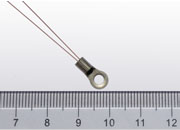
Thick-film or metal-oxide film high-voltage resistors (rated 1 kV to 100 kV) are the most straightforward choice. Select for: voltage rating ≥ 1.5 × V0; resistance from Eq. (3); power from Eq. (5) with 2× derating; and pulse energy within the manufacturer's rating.
6.2 Cost-Saving Alternative: Standard Resistors in Series
Standard carbon-film or metal-film resistors are rated only 200 V to 500 V working voltage, but they are inexpensive and universally available. By connecting N identical resistors in series, each one sees only a fraction of the full supply voltage, keeping every resistor within its individual rating. This is an effective, low-cost alternative to a single dedicated high-voltage resistor.
If each standard resistor is rated Vrated (typically 200 V to 500 V), the minimum number of resistors N required is:
N ≥ V0 / (0.8 × Vrated) (6)
Each individual resistor has the value:
Reach = Rs / N (7)
During an arc event the total voltage V0 appears across the series chain, so each resistor sees:
Veach = V0 / N ≤ 0.8 × Vrated ✓ (8)
The power is shared equally, so each resistor dissipates only Ps/N of the total. A standard 0.25 W or 0.5 W resistor is often more than adequate.
Example - 5 kV supply, Vrated = 400 V per resistor, Rs = 3.3 MΩ:
N ≥ 5,000 / (0.8 × 400) = 15.6 → Use N = 16 resistors
Reach = 3,300,000 / 16 = 206 kΩ (use 220 kΩ standard value)
Each resistor then sees 5,000 V / 16 = 312 V at peak arc, well within its 400 V rating. Space the resistors evenly on the PCB to distribute heat and maintain adequate creepage distance between adjacent bodies.
7. ATI High Voltage Power Supply Products
ATI's HVPS range covers DC-DC modules (5 V, 12 V, 24 V, 30 V input), AC-DC benchtop and 1U/2U rack-mount supplies (up to 50 kV, 10 kW), capacitor-charging modules, and I/O-proportional models. All feature galvanic isolation, built-in arc protection, < 0.02% RMS ripple, and >90% efficiency. Combined with the external Rs described here, two independent layers of over-current protection ensure maximum reliability and long service life.
For datasheets listing rated maximum current Imax and output capacitance C0 for each model, visit www.analogtechnologies.com or contact the ATI applications engineering team.
8. Design Procedure Summary
For More Information
Analog Technologies, Inc. • 1161 Ringwood Ct., #110, San Jose, CA 95131, U.S.A.
Tel: 408-748-9100 • www.analogtechnologies.com