A
laser driver is a precision current-control (CC) or optical-power-control (CP) circuit that delivers a clean, regulated drive to a
laser diode while managing startup, shutdown, noise, modulation, monitoring, temperature, and fault protection. A laser diode is
current-operated: past threshold, a small voltage change makes a large current change, and a brief transient can destroy it — so a driver is built as a controlled
current source, not a voltage supply.
Download the full white paper (PDF)
AWLSD-01 · theory, a worked selection example, troubleshooting, and an ATI product-selection guide — built for the bench
Download PDF ↓
1. Why a current source, not a voltage source
A diode's current rises sharply with small voltage changes, so regulating voltage allows unsafe excursions that can destroy the diode in microseconds. A current source regulates the variable that actually sets optical output and electrical stress. The driver sits between the supply and the diode: OV/UV protection and EMI filtering, soft start, an output stage (linear or high-efficiency PWM), and a feedback loop closed by either a current sense (CC) or a monitor photodiode (CP) — with monitoring reported back to the system controller.
2. Two modes: constant current vs. constant power
|
CC — Constant Current |
CP — Constant Power |
| Feedback | Current (sense resistor) | Light (monitor photodiode) |
| Holds | Drive current steady | Optical power steady |
| Strength | Simple, fast, robust; predictable stress & current limiting | True light output; best long-term power & wavelength stability |
| Watch-out | Optical power drifts as the diode heats / ages | Needs a monitor photodiode and clean feedback |
Many systems alternate: CP at low power for optical stability and CC at high current where protection dominates.
3. Key engineering takeaways
• Compliance voltage: the driver must develop Vf plus sense and cable drops, or the loop saturates below the commanded current.
• Soft start & turn-off: ramp current gently at turn-on and shutdown so the diode never sees an inrush or stored-energy spike.
• Compact output loop: keep laser wires under ~10 cm and the LDA→laser→LDC loop area under ~5 cm², routing outgoing and return conductors close together, to cut inductive ringing and EMI.
• PWM beat frequency: keep the driver's PWM rate away from the supply's (or synchronize) — their difference is a low tone that is hard to filter.
4. Noise, organized by frequency
A "low-noise" driver is not solved by one capacitor. Sort the mechanisms by frequency region first, then apply the fix that targets each region.
| Region |
Frequency |
Mechanism |
| Drift | DC–0.1 Hz | Thermal / reference drift |
| 1/f flicker | ~0.1 Hz–1 kHz | Flicker noise (the actual low-freq noise) |
| White floor | ~1 k–100 kHz | Broadband thermal/shot noise |
| Loop peaking | 100 k–MHz | Control-loop resonance |
| PWM ripple | fsw + harmonics | Periodic switching ripple |
| EMI / RF | MHz–100s MHz | Radiated / conducted interference |
Terminology: "corner noise" is not a noise type. The low-frequency noise is 1/f (flicker) noise; the noise corner frequency is the point where the falling 1/f noise meets the flat white-noise floor. PWM ripple and EMI are periodic (discrete frequencies), not white — so you filter them differently.
5. Why ATI laser drivers
• Full protection — soft start/turn-off, current limit, over-current, over-temperature, supply UV/OV, reverse polarity.
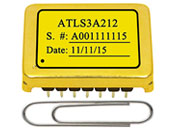
• Low noise — 0.05% current-output noise (ATLSxA201D); extra-low noise (ATLSxA106).
• High stability — typically <100 ppm/°C, with temperature compensation available.
• High efficiency — >90% (ATLSxA201D / ATLSxA202D), lower self-heating.
• Compact & shielded — small DIP modules; six-sided metal enclosure for zero EMI.
• Monitoring — real-time current monitor, 2.5 V reference, and photodiode optical-power feedback.
Vacuum-compatible, low-outgassing, fully potted module options for space / UHV / sealed instruments are available on request —
contact ATI engineering to confirm part numbers and outgassing data.
6. Choose the right ATI driver
| If you need… |
Consider |
Why |
| Lowest noise at ≤500 mA, modulation to 100 kHz | ATLSxA106 | Extra-low noise, ~1.5 µs rise/fall, temp-compensated |
| High-efficiency CC, 500 mA–6 A, compact shielded | ATLSxA201D | >90% eff, 0.05% noise, zero-EMI DIP |
| Multiple switchers on one board | ATLSxA202D | 520–800 kHz PWM synchronization to avoid beat interference |
Common applications: telecom & fiber lasers, DPSSL pumping, EDFA, spectroscopy, metrology & sensing, medical & diagnostics, imaging, industrial & instrumentation. See the full
laser driver selection guide.
FAQ
What is a laser driver? A precision current- or optical-power-regulation circuit that supplies controlled current to a laser diode while managing startup, shutdown, noise, modulation, monitoring, temperature, and faults.
Why a current source, not a voltage source? A diode's current changes sharply with small voltage changes, so regulating voltage allows unsafe excursions; a current source regulates the variable that sets optical output and stress.
What is the difference between CC and CP mode? CC regulates current directly; CP uses monitor-photodiode feedback to regulate optical power. Some systems use CP at low power and CC at high current.
Why does laser-driver noise matter? Current noise becomes optical-intensity noise, wavelength variation, and measurement error. In precision optics, quiet current usually means more useful light.
How short should the laser output wiring be? Keep laser wires under ~10 cm and the LDA-to-laser-to-LDC loop area under ~5 cm², routing outgoing and return conductors close together.
Get the full AWLSD-01 white paper
For a fast RFQ or selection help, send ATI: diode current & absolute-max current · forward voltage (Vf) · CC or CP · modulation bandwidth · current-noise target · thermal/ambient conditions · mechanical/sealing constraints.
Download PDF ↓
Talk to ATI engineering